If you spend any time watching serious pickleball — the pros on the PPA Tour, the top players at your local 4.0+ open play, or the coach at your club who wins everything — you'll notice one thing they all do that most rec players don't: they hit the third shot drop.
Not every third shot has to be a drop. But the ability to hit one on demand, from anywhere on the baseline, off any return, is the single biggest technical dividing line between the 3.0 world and the 4.0+ world. In this guide we'll break down exactly what the third shot drop is, why it matters, what makes it so hard, and — most importantly — the drills and mental cues that will actually get you there.
What the third shot drop actually is
The third shot drop is a soft, arcing shot hit from the baseline (usually just after your team serves and receives the return) that lands in your opponents' non-volley zone — the kitchen. Because the ball bounces low and short, your opponents can't attack it. That gives you and your partner time to move up from the baseline to the kitchen line, where every real pickleball point is decided.
Count it out: shot one is your serve, shot two is their return (they're already at the kitchen line), shot three is yours to hit — from way back at the baseline — while your opponents have all the positional advantage in the world. If you drive shot three, they'll usually block it back down at your feet and you'll be stuck in the transition zone getting picked apart. If you drop shot three softly into their kitchen, they have to hit up on the ball, and you get to walk in.
Why so many players avoid it (and pay the price)
Most players default to driving the third shot for one simple reason: it's easier to hit hard than to hit soft. A drive is a full-body swing. A drop is a controlled, decelerating stroke with a specific spin, arc, and target. It's a touch shot, and touch is harder than power.
The unspoken second reason: a bad drop is punished immediately. If you leave a drop too high, your opponents will pound it into the ground before you've taken two steps forward. That fear makes players revert to drives, which fail differently — you don't lose the point outright, you just stay stuck in no-man's land. Both paths lose you the point, but the drop failure feels worse because it happens faster.
The reality: at the 4.0+ level, drives get blocked, punched, or counter-attacked. The drop is not optional forever. It's the ticket in.
The mechanics: what a good drop actually looks like
Break it down into five checkpoints:
- Low-to-high swing path. Your paddle starts below the ball and lifts up and through the shot. Think of scooping — not swiping. This creates the arc that peaks near the net and then dies short.
- Continental or slight Eastern grip. Same grip you use for dinks. Do NOT switch to a forehand groundstroke grip just because you're at the baseline — you'll add power and lose feel.
- Contact out in front, at or below waist height. If the ball is above your waist by the time you contact it, you've waited too long. Move your feet earlier.
- Slow paddle speed with a full follow-through. Counterintuitive but critical. A short, jabby swing is inconsistent. A long, slow, complete swing gives you feel and repeatability. Aim for a follow-through that finishes near your opposite shoulder, not stopped at the ball.
- Target the kitchen line, not the net. Aim your peak arc to be roughly over the net cord (or slightly past it) so the ball descends into the kitchen. Aiming AT the net will produce nets. Aiming for a spot 3–4 feet inside the kitchen tends to produce clean drops.
The mental model: it's an approach shot, not a winner
The single biggest reframe for most players: the drop is not designed to win the point. It's designed to neutralize the point long enough for you to move to the kitchen line. If your drop lands anywhere in the kitchen and forces your opponents to hit up, you have won that drop, even if the rally continues for 15 more shots. Stop expecting the drop to be a killer. Start treating it as a bridge.
Related: you don't have to hit ONE perfect drop. You can drop again on shot five, shot seven, and shot nine as you and your partner work your way forward. This is called a "reset" and pros do it constantly. Even a drop that gets popped up a little is fine if you're steadily moving forward and your opponents can't get an outright attack on it.
The drills that build this shot
Reading about the drop won't get it into your game. Reps will. Here are three drills, in order of difficulty, that will get you from "I can hit one on a good day" to "I can hit one under pressure":
Drill 1: The static drop (10 minutes)
Stand at the baseline. Have a partner or a coach at the kitchen line drop-feed you balls at chest height, one after another. Your only job: land 10 in a row in the kitchen. Slow, controlled, no drives. If you miss, restart the count. This is a feel drill — no footwork, no pressure, just paddle-on-ball touch.
Drill 2: The moving drop (15 minutes)
Same setup, but now your feeder puts the ball 3–4 feet to either side of you. You have to move, set up, and drop. This adds the reality of the real third shot: you're never planted, you're always moving to the ball off a return.
Drill 3: The three-shot pattern (20 minutes, live)
Serve, get a return, hit ONLY drops. No drives allowed. Play the point out. This is where most players discover their drop is a mirage — it works in drills but collapses in live points. That's fine. Struggling here is the whole point. Do this every practice until your drop under pressure looks like your drop in drills.
When NOT to drop (yes, there's a time to drive)
The third shot drop is the default at 4.0+, but it isn't the answer every single time. Drive the third instead when:
- The return floats short and high, giving you a chest-height ball at the baseline — this is a gift, take it.
- Your opponents are slow to recover to the kitchen line and there's a gap you can exploit off the bounce.
- One opponent has a weak backhand and you can target it with pace.
- You've been dropping successfully all game and want to change the pattern to keep them honest.
The rule of thumb: drop by default, drive by exception. Not the other way around.
How long until you own this shot?
Honest answer: three to six months of deliberate practice, not just playing. Playing more open-play games will not teach you the third shot drop. Drilling it will. Most players who make the jump from 3.5 to 4.0 credit the third shot drop as the shot that unlocked the level. It's not glamorous. Nobody at the bar tells stories about their drop. But it's the shot that gets you to the kitchen — and the kitchen is where the game is actually played.
Gear notes: does your paddle matter?
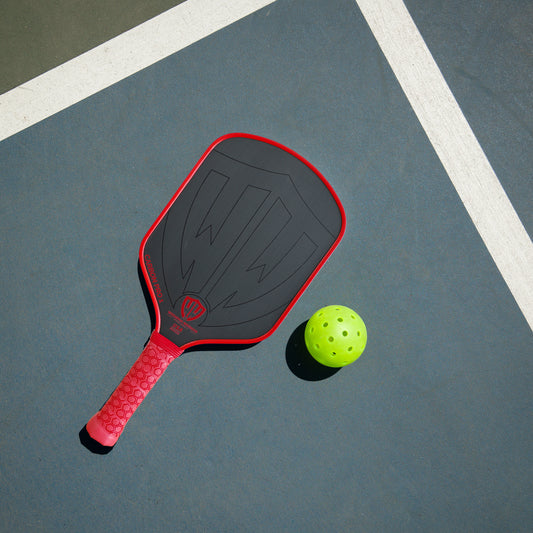
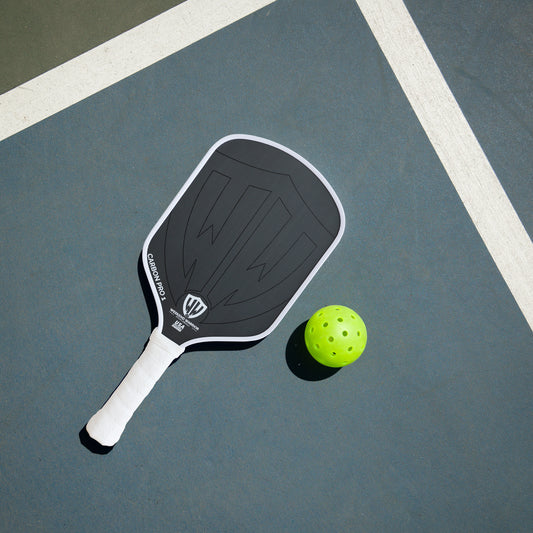
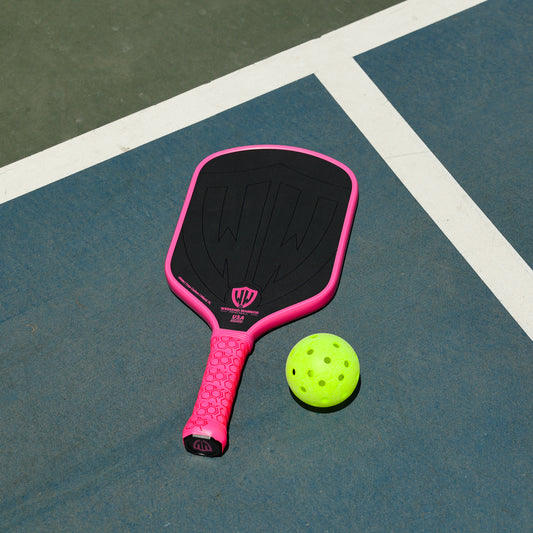
A little, but less than you'd think. Any paddle with reasonable touch will hit a drop — the shot is 90% mechanics and 10% equipment. That said, softer face paddles (raw carbon fiber, especially thicker 16mm cores) tend to be more forgiving on drop shots because they absorb some of the ball's energy rather than launching it. If you're grinding on drops with a hot, pop-heavy paddle designed for power, you're fighting your equipment. Something more control-oriented will let you feel the shot better while you're learning it.
But before you buy a new paddle — drill the drop with what you have. Ninety percent of "my paddle can't drop" is really "I haven't drilled enough drops."
The bottom line
The third shot drop is the shot that separates rec pickleball from real pickleball. It's harder than a drive, it fails uglier when it fails, and it takes months of drilling to make reliable. It's also the single most valuable shot you can add to your game if you want to break into the 4.0+ world. Start with static drops today. Add movement next week. Play three-shot-pattern games next month. Six months from now, you'll wonder how you ever played without it.
Ready to work on your soft game? Check out our full paddle collection at Weekend Warrior Pickleball — we stock control-oriented options built for players who want to master the drop.